More Classwork!

Well summer is officially here as my last class ended last week for the semester. I delivered a number of really wonderful final projects for all of my classes.

Classes I took this semester:

Composer Performer II

Advanced Studio Recording and Engineering

Film Scoring I

Advanced Mixing and Mastering

Music History 18/19th Centuries

Synthesis and Sampling

Seminar/Private Instruction

Below are some finished examples from school projects:


Our Advanced Studio Recording and Engineering class had us learn various microphone techniques for recording live performances. Each week, students rotated studio jobs from deck engineer to pro tools op to patchbay and notetaker as well as mix/master post engineering jobs while taking one week to full produce (that means hire talent!) a track. My week of production was a foley and efforts pass of a personal project I’ve been working on: a fight scene from the hit animated show Arcane. I also mixed and mastered a jazz duo playing Hancock’s Maiden Voyage. Such a wonderful class!


Composer Performer II was a class about writing music you intend to perform in some public way, whether that be in person or using an installation with sound and visuals. My midterm had me playing with some fun mirror effects in Adobe Primer using a field recording walk the class embarked upon back in March. I sped up the audio to match the video, but mirrored the audio by reversing it and playing it with the sped up version.

The final: I wanted to do about simulating a rocket shuttle blasting off in various parts using my instrument (tuba) to create a beautiful melody about blasting off into space and the emotional experience through music and sound. Our poetic note for the program was thus:

April 12, 1961. 

Industries roared and cities surged forward, rising like titans from the earth, forging steel dreams in fire and light—the world accelerating towards the impossible.

10…9…8…7…6…5…4…3…2…1

Blastoff!

 
Flames carved the sky as thunder rose from the earth, the ground trembling beneath the fury of ascent. Through cloud and storm, through silence and void, we rose—carried by fire, into the vast and waiting dark.

We are stardust.


Film Scoring was by far my most challenging class because scoring anything with music ON PURPOSE was relatively uncharted territory for me aside from some very minor things I did over 10 years ago. We were assigned a slew of projects to be delivered on a weekly basis that had us composing for a variety of different film clips. The iPhone balloons was definitely my favorite of the bunch here!


Overall I produced a ton of content, and I even challenged myself to work on a Film Audio Faceoff competition over at Airwiggles for a short called Binocular Trick. Another really fun project to work on!

Really excellent way to start my semester here at SFCM. Looking forward to a relaxing but productive summer and I’ll be back in the fall for more new projects.

Have a great summer, y’all!

~MJ
VFS Final Project - Anomaly 2

This was my final audio project at VFS, and utilizes all of the audio skills I learned in this past year. The audio is a complete re-design with the majority of original audio added to the sound edits. The music provided by 5 Alarm.

VO:

I recorded the voice over and the majority of the sounds for the final trailer. I used McDSP's Futzbox plugin to get the radio effect for the introduction and scavenger voices; I made a wet/dry mix with a low-passed signal of the recorded audio as the dry. For the commanders helmet reverb, I took an impulse recording of a ripped piece of air duct from the factory and used it as the dry signal with a different futz as a wet. Overall, the process was very challenging. The human voice contains many nuances on top of adding in processing from both reverbs and radio futzs. I had a lot of EQing to do in order to balance the quality of the voice with the effect I wanted in the end.

SFX:

Many of the mechanical sounds for the B-E-A-R tank were recorded in a real metal factory with a few library sounds to accent the current design. The evil dinosaur bots were designed from the squeaks of various doors opening and closing at the film school combined with bowing an old metal oil drum. The intro was especially fun to work on; I took a lot of recorded announcer dialogue from previous VFS school projects (with permission of course) and futz them in combination with sonar pings and radio tuning, distortion, and static. It made for a great opening soundscape to establish the context of the rest of the action later on. Many of the snow sliding sounds were taken from a skiing trip at Cypress mountain in northern Vancouver. The laser and gun design was all done with Komplete Synths: Massive and Reaktor 5.

The most challenging thing for me personally was perspective. With POV (point of view) changes, I had to take into account how much "air" or distance was between the camera and the point source of the sound. I took this into account when recording a lot of the mechanical sounds and ended up making three batches of recordings: close, medium, and far distances. This gave me more leeway when I added my edits.

I hope you enjoy the final redesign of this Anomaly 2 animated intro!

~MJ

Film School Shorts

Hey all!

So—with film school in its 5th and almost final block (out of 6), I just got back from the film school’s premiere of the film shorts we worked on in collaboration with the film school. Part of the curriculum had us go through the entire sound pipeline for a film, from pre-production to production sound, all the way to post-production and mastering. We navigated through an intense but brief process and collaborated with the school’s film department to orchestrate 7-10 minute full shorts over the course of four months. A student in the sound department would work production on a film, then would work as an editor and then as either dialogue or SFX mixers for the same film two months later in the pipeline, working with all of the turnovers, AAFs, stems, EDL’s, and handoffs as they happened. However, while the average class was between 12-15 people, we only had 6 in our class, meaning that we had the added challenge of recording, editing, and mixing not one, but two short films instead and working as both dialogue and SFX mixers. It was an amazing experience, and I truthfully wished the entire curriculum was a lot longer—I just wanted to keep making more films!

Dr. Voodoo was the very first short I worked on. I worked production sound for both the pilot and part II and then edited both SFX and dialogue on both versions later on. This often meant a lot of hurry-up-and-wait on sets. As teams of three, we swapped roles on production sound as the boom operator, the on-set mixer, and the sound assistant. It’s amazing how much time and work has to be done to only record a short amount of footage that later gets chopped down even finer as the production pipeline continues! Needless to say, I gained an astronomical ton of respect for anyone that works in film production from that point onward. I loved working on editing the dream sequences in these especially! Check out both episodes here:

I worked next on the Brenda the Exterminator series. (and another called “The Job” that I unfortunately cannot find) I worked several audio post jobs due to the size of our class: I mixed the dialogue and music, recorded and edited the walla/looping, ADR, and foley, and was the music supervisor and music editor. The dialogue mixer is probably the most important position at the console on a sound stage. We have a saying in the sound industry that “dialogue is king” and that is definitely the truth. A sound mix for a film is separated into three parts that all have different tracks and routing: dialogue, music, and effects. On larger films, there’s usually a dialogue mixer who mixes dialogue and music and a sound effects mixer to mix sound effects, often separated into subcategories such as backgrounds, sound design, and foley. The dialogue mixer will level and attenuate all the volume set to the dialogue, meaning the dialogue will always sound the loudest and come to the forefront of the mix. The dialogue mixer also has to make sure the dialogue sounds smooth using different software plugin tools like equalization (EQ) and compression. The mixer is also responsible for making sure the dialogue sounds “in the space” of where the scene is taking place, including any ADR (automated dialogue replacement) tracks that contain dialogue that was re-recorded in a studio to replace non-desirable dialogue lines from production. For example: on Brenda, there’s a scene where she starts talking while in an enclosed area that used ADR lines, so I added some reverberation at that moment to create a sense of realism that she’s actually saying what she’s saying in that space. I also had the added fun of deciding what kind of filter I wanted to use for all of the phone calls. In the biz, we term that as “futz.”

I have to say, re-recording mixing was unlike anything I have ever done in the profession. It felt like an extremely unique, complex, and organic process, one that was constantly changing and expanding due to the nature of replaying certain parts or scenes over and over again while using automation to write and re-write volume, pan, or any other parameter for a plugin that the mixer would design. We each mixed four short films and a final project in a span of four months as part of our curriculum; I truly wanted to work another year, hell, two years, just to understand all of the nuances of re-recording mixing and the editing-> mixing pipeline process.

Check out Brenda Part II here:

…and now it’s time to dive into the final 8 week block of school and to start working on my final. I’ve got a video already lined up and I’m planning a trip to Cypress mountain planned to record myself on skis for some of the sfx. That, and a mechanical shipyard for a lot of robot and servo sounds. I won’t reveal anything more but it’s going to be a ton of work, and after 10 months of schooling, I feel like I’m more than ready for it. Stay tuned for the final video in the month to come!

10-4

~MJ

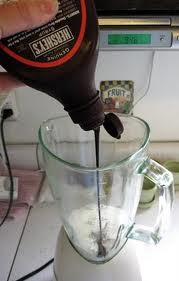
Victories using ze chocolate syrup!

Why yes, this is indeed audio related! For weeks and weeks my client has been ripping my monster sounds to shreds. “Needs to be bigger with less layers, more guttural, more crazed and chaotic.”

As I’m making chocolate milk I noticed the *blub* sound it made when the container was almost empty. I recorded it, processed it with a jackhammer I recorded a few days prior, and yelled into a vocoder with both sounds as impulses with plenty of reverb. I submitted it a day early; my client absolutely loved it.

I just solved a huge work problem by making chocolate milk. Victory never tasted so sweet.

P.S. no April Foolery with this one. This is very real! Yee haw!

~MJ